Menu Products
Comparison lists
Product comparison
4 / 4 article
max. number for this category reached!
Please remove at least one article from the category to add further articles.
Comparison lists
Product comparison
was added to the comparison list.
Add article
You will need to add the products to the comparison list to compare them.
Comparison lists
Product comparison
fr de en

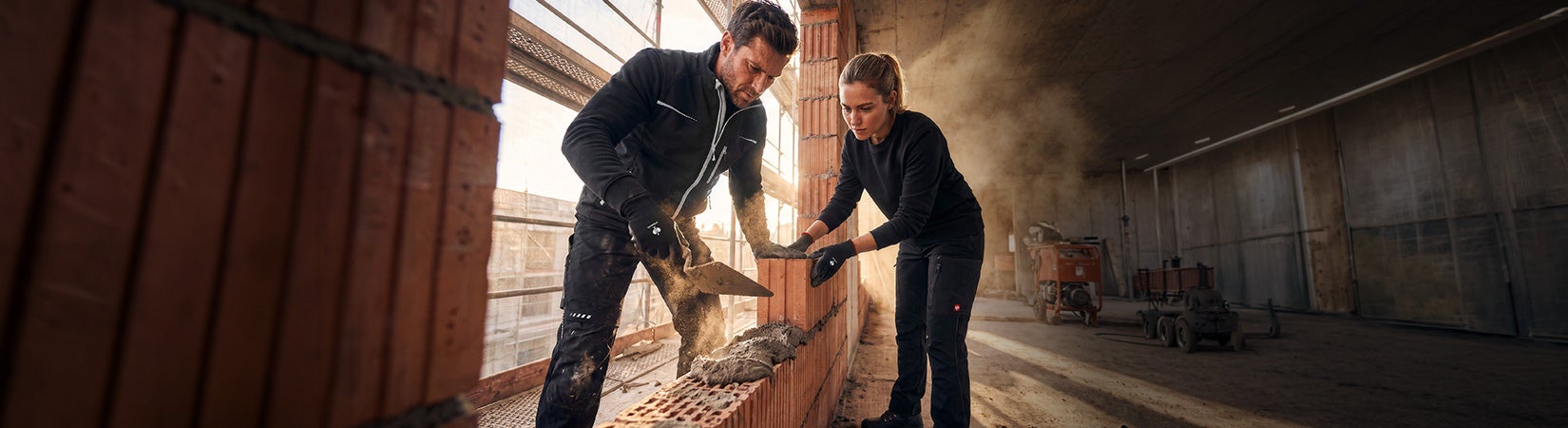
Workwear for bricklayers: Built to withstand the demands of everyday construction work


Strenuous physical work in a demanding environment with lots of dirt and constant contact with mortar, bricks, and sharp edges wears down clothing. Workwear for bricklayers must therefore offer uncompromising durability without restricting the wearer when they are bending or kneeling. Strauss offers a full range of workwear for bricklayers, including safety shoes and protective equipment, all from a single source.

for men
for women
Workwear for bricklayers: Built to withstand the demands of everyday construction work

Strenuous physical work in a demanding environment with lots of dirt and constant contact with mortar, bricks, and sharp edges wears down clothing. Workwear for bricklayers must therefore offer uncompromising durability without restricting the wearer when they are bending or kneeling. Strauss offers a full range of workwear for bricklayers, including safety shoes and protective equipment, all from a single source.
for men
for women
Workwear for bricklayers: Built to withstand the demands of everyday construction work

Strenuous physical work in a demanding environment with lots of dirt and constant contact with mortar, bricks, and sharp edges wears down clothing. Workwear for bricklayers must therefore offer uncompromising durability without restricting the wearer when they are bending or kneeling. Strauss offers a full range of workwear for bricklayers, including safety shoes and protective equipment, all from a single source.

for men
for women
Workwear for bricklayers: Built to withstand the demands of everyday construction work

Strenuous physical work in a demanding environment with lots of dirt and constant contact with mortar, bricks, and sharp edges wears down clothing. Workwear for bricklayers must therefore offer uncompromising durability without restricting the wearer when they are bending or kneeling. Strauss offers a full range of workwear for bricklayers, including safety shoes and protective equipment, all from a single source.

for men
for women
info
Workwear for bricklayers: Built to withstand the demands of everyday construction work
for men
for women
KI-generiert / modifiziert - Two people work on an open electrical cabinet.
AI
Filter
Popularity
Newest first
Price descending
Price ascending
no filters found
Unfortunately, this service is currently not available. Please try again later.
Size
Colour
Men | Women | Children
e.s. Collection lines
59 Products
More filters59Filter (59)
Popularity
Size
Colour
Men | Women | Children
e.s. Collection lines
59 Products
More filters59Filter (59)
Popularity
Shorts e.s.motion Summer
from 
4colours
NEW
Winter bodywarmer padded e.s.line.core
from 
5colours
Ladies' trousers e.s.vision
from 
6colours
e.s. Hoody sweatjacket poly cotton
from 
15colours
Winter softshell jacket e.s.motion 2020, ladies'
from 
12colours
NEW
Winter jacket padded e.s.line.core
from 
5colours
S3 Safety boots Salzburg
from 
1colour
Cargo shorts e.s.motion ten Summer
from 
6colours
NEW
Softshell jacket e.s.line.core
from 
5colours
e.s. Craftman's Work Trousers Albert
from 
1colour
NEW
Jacket double climafoam e.s.line.core
from 
5colours

The essentials of workwear for bricklayers at a glance


  • Workwear for bricklayers requires robust knee panels and reinforcement in high-wear areas – for example, with triple-stitched seams or polyamide – because the fabric is subjected to particular strain from contact with various building materials and frequent bending and kneeling.
  • Because the German Social Accident Insurance Association for the Construction Industry (BG BAU) classifies construction occupations such as bricklaying as having a particularly high risk of accidents based on DGUV statistics, personal protective equipment (PPE) is essential.
  • Safety shoes for bricklayers require a robust scuff cap and high protection classes (S3/S7) because stones, sharp objects, falling building materials and damp, slippery surfaces pose a constant risk to the feet.
  • Grey and brown are the dominant colours in workwear for bricklayers because dust is less noticeable against these colours while heavy soiling remains visible. 
  • Strauss is a one-stop supplier of workwear for bricklayers – from guild trousers to safety shoes, all from a single range.

Why bricklaying places particular demands on workwear


The harsh working environment on the building site, abrasive materials, and heavy physical strain mean that workwear for bricklayers must combine protection, durability, and freedom of movement:

  • Day-to-day work involves a great deal of physical labour such as laying stones, building walls, pouring foundations, and installing steel mesh. This means working in a squatting position and repeatedly standing up and kneeling down. 
  • Mortar, plaster, bricks, and other rough building materials also cause considerable wear to clothing. Experience shows that the thigh area is particularly prone to wear because materials are often rested there during construction work.
  • Workwear for bricklayers must be not only hard-wearing but also ergonomically designed to support freedom of movement during everyday work on a building site.

Weather conditions must also be taken into consideration. Bricklayers work outdoors for much of the year – whether it’s raining in spring or hot in summer. The layering principle is therefore highly recommended: waistband trousers or bib & brace trousers combined with a waistband jacket and T-shirt plus a weatherproof jacket, warm fleece jacket or troyer, and softshell jacket that can be quickly added or removed as needed.

The BG BAU recommends that construction trades follow the TOP principle: technical, organisational, and personal protective measures – the latter include appropriate PPE such as safety shoes and a safety helmet.

What colours does workwear for bricklayers typically come in?


When it comes to choosing colours, grey and brown have become the standard in bricklaying because dust is hardly noticeable on them while heavy soiling remains visible. In high-wear areas such as the knees or seat, these base colours are often combined with darker contrasting colours in Strauss collections. This creates a modern look perfectly suited to bricklaying.

What do work trousers for bricklayers need to withstand?


You can recognise a good pair of work trousers for bricklayers by these details:

  • Reinforced knee areas and knee pad pockets provide protection for the wearer and the fabric when they are kneeling on screed, concrete, or gravel.
  • Triple stitching withstands the strain of pulling and abrasion in high-wear areas for considerably longer than single stitching.
  • Stretch inserts greatly increase freedom of movement when bending down, lifting, and kneeling.

Tip: In the Strauss range, you can filter specifically for work trousers with these features – for example, by the features triple-stitched seams and reinforced knee areas.

For those committed to the traditional style of the trade, classic guild trousers remain a popular choice. Guild trousers have been part of the bricklaying trade for generations and are still worn today, particularly by journeymen travelling from place to place. Traditional guild trousers are usually made of particularly heavy double-twisted cotton (Doppelpilot), a dense, sturdy fabric long valued for its durability.

The e.s. Concrete Workers’/Bricklayers’ Guild Trousers Doppelpilot Albert, without flare combine tradition and functionality with everything bricklayers need: hard-wearing fabric made of 100% cotton in a robust Doppelpilot fabric with extra knee reinforcement. The details reflect first-hand experience of working on a building site. These include traditional metal zips, two inner buttons at the waistband for additional support, and reinforced pocket hems made of sturdy CORDURA® for greater durability. There are also two side pockets, a back pocket with a flap and button, and a ruler pocket – each with synthetic leather corners to ensure they can withstand daily wear and tear. The standard leg width without flare creates a classic, straight fit.

The modern, functional, and hard-wearing work trousers from the collection e.s.motion 2020 ensure greater freedom of movement. The ergonomic cut has a modern silhouette and fits close to the body without restricting movement: The Flexbelt® waistband stretches at the sides for unrestricted movement, and the extra-strong triple-stitched seams on the inside leg withstand the daily strain of bending and stretching. The reinforced knee area and back pockets are made of sturdy polyamide. Wide belt loops with Velcro fasteners for an additional tool bag and a practical ruler pocket are other useful features for everyday bricklaying work. The polyester–cotton blend combines durability and comfort.

Also perfect for bricklayers: The modern stretch collection e.s.dynashield consistently features triple-stitched seams because anyone who spends all day kneeling, bending, and stretching needs more than double stitching. Stretch elements in the highly hard-wearing bXeric® double-weave fabric provide freedom of movement despite the increased durability – particularly important when frequently switching between standing and kneeling.

Another robust alternative is the e.s.prestige – a collection consistently designed for durability. It is ideal when the material and workmanship need to offer even greater durability.

Bib & brace trousers or work trousers: What is the best choice of workwear for bricklayers?


There is no single answer as to whether bib & brace trousers or work trousers are the better choice – it ultimately comes down to personal preference. Both styles are equally common in bricklaying, and each has its advantages depending on how you work.

For work that involves spending a lot of time on your knees, bib & brace trousers reliably cover the back with every movement. This is a noticeable advantage, particularly when constantly switching between standing and kneeling. The functional bib & brace trousers e.s.dynashield are extremely robust and stretchy: with reinforced knees, including knee pad pockets, and the freedom of movement this collection is known for.

For those who prefer classic work trousers, Strauss has various models designed for bricklaying. The range also includes specialist weatherproof trousers such as the functional work trousers e.s.prestige, which are particularly suitable for wet and extreme weather conditions. Thanks to the dryplexx® membrane, these trousers are waterproof, windproof, and breathable. They provide protection even on wet autumn days and feature a clever pocket design.

Outerwear for bricklayers: What is important when it comes to jackets and shirts?


Bricklayers constantly work at a wide variety of working heights – bending down and stretching. Outerwear for bricklayers must therefore be cut to move with the wearer without riding up: a longer back and stretchy shoulder inserts provide greater comfort on the building site.

Because bricklayers spend much of the year working outdoors, the layering principle is particularly useful for outerwear:

  • T-shirts and polo shirts form the first layer directly against the skin – breathable and moisture-wicking, so that sweat is quickly drawn away during physical work.
  • Fleece jackets or troyers keep you warm on chilly days without getting in the way as you work.
  • Softshell jackets such as the softshell jacket e.s.motion 2020 combine a robust, wind- and water-repellent outer fabric with a soft, padded lining. This makes the jacket ideal for both the building site and frequent transitions between indoors and outdoors.
  • Weather protection jackets form the outermost layer in persistent rain and complement the softshell or fleece layer. 3-in-1 jackets are also a practical solution for bricklayers.

Tip for the summer: If you regularly work outdoors, it’s worth taking a look at functional shirts and jackets with UV protection. Headwear also provides protection in summer.

Safety shoes for bricklayers: A comparison of protection classes


Broken bricks, falling stones, tools lying about and wet surfaces are all part of everyday life on a building site. Safety shoes for bricklayers must therefore feature a puncture-resistant sole, a sturdy toe cap and secure grip on varying surfaces. The relevant standard is EN ISO 20345. Since the standard was revised in 2022, it has distinguished between the established S1 to S3 classes and the new S6/S7 classes, which additionally guarantee permanent waterproofness of the entire shoe. For bricklayers, two types are particularly relevant:

Protection class

Properties:

Useful for:

S3

toe cap, puncture-resistant sole, water-repellent upper, slip-resistant (SR/SRC)

dry to moderately damp site ground, standard structural work

S7

complies with S3; additionally certified as fully waterproof according to EN ISO 20345:2022

persistent damp, periods of rain, standing water on the building site

The following models, amongst others, are particularly suitable for bricklayers:

  • The S3 safety shoes e.s. Sawato mid combine a steel toe cap and steel puncture protection with a slip-resistant SR sole for use on varied construction site surfaces.
  • The S3 safety shoes e.s. Katavi mid feature a deep tread, a cold-insulating (CI) construction, and robust cowhide leather – a classic choice for year-round outdoor use.
  • For additional protection against wet conditions, the S3 safety shoes e.s. Kastra II mid with dryplexx® membrane provide protective properties comparable to those of the new S7 class.
  • The S3 safety shoes e.s. Umbriel II mid are a classic style for the building site and combine sturdy leather with a cold-insulating sole.

PPE for bricklayers: reliable protection for your knees, head, and hands


In addition to the workwear itself, bricklaying requires well-designed PPE. Under the Occupational Health and Safety Act, the employer must provide the necessary PPE and pay for it. When selecting PPE, three key areas require particular attention: the knees, head, and hands.

Knee protection for bricklayers


Daily kneeling requires padding that evenly distributes pressure while allowing freedom of movement. The EN 14404 standard applies to certified knee protection. It sets out requirements for knee pads for kneeling work positions and classifies them by type and performance level. For example, Type 2 is designed for use without a firm surface, as is common on construction sites.

The ultra-lightweight e.s. Knee Pad Ergonomic is certified to EN 14404 for use with numerous Strauss work trousers. For trousers without integrated knee pad pockets or shorts, an external knee pad pocket such as the e.s. Knee Pad Pocket Pro-Comfort is a practical option – it straps on and is available in ‘soft’ and ‘rough’ versions for different surfaces. For longer periods of work at ground level, the e.s. Knee Board Pro-Comfort helps protect your knees: The padded rolling board on four PU castors reduces strain on the knees and back.

Head protection


On the building shell, there are risks from above: building materials, tools, or other items falling from scaffolding or cranes. A safety helmet that conforms to EN 397 is therefore compulsory equipment when such hazards are to be expected. Among other things, the standard specifies requirements for shock absorption, penetration resistance, and flame spread. To ensure that the helmet provides proper protection in an emergency, it must be adjusted to fit perfectly and should be replaced after a heavy impact – even if there is no visible external damage.

The e.s. work helmet Worker is certified to EN 397:2012+A1:2012 and protects against impacts from objects falling from scaffolding or cranes. The extended neck flap keeps out the sun and dust, ventilation slits and washable padding ensure a cool fit in heat, and the chin strap provides support when moving your head. If an entire team must be outfitted or an affordable solution is required, Strauss also has classic white safety helmets as a reliable basic option – with a suitable choice for every budget.

Hand protection


Constant contact with stones, mortar, and tools puts considerable strain on the hands during bricklaying. In this context, the relevant standard for the selection of PPE is EN 388: It describes resistance to mechanical risks such as abrasion, cuts, tearing, and punctures. Four to six ratings on the label indicate these values; the higher the ratings, the more durable the glove. When working with wet mortar or concrete, it is also important to check the grip the gloves provide when wet because smooth gloves can quickly lose their grip.

Strauss offers a wide range of work gloves. The following models are particularly suitable for bricklayers: The split leather gloves Cooper are reinforced in several places and are ideal for prolonged work with stones and mortar. For winter, there are the lined full-grain leather winter gloves Yukon, while the coated nitrile gloves Monza offer an alternative to leather and provide grip even when handling wet materials.

High-vis clothing on large construction sites


Where excavators, cranes, and delivery vehicles operate alongside people on the same construction site, good visibility can save precious seconds that make all the difference in an emergency. The relevant standard is EN ISO 20471, which classifies high-vis clothing into visibility classes 1 to 3 – depending on the area covered by fluorescent material and retro-reflective strips. Class 3, the highest level, can be achieved either by combining several certified items such as high-vis trousers and a jacket or by wearing an individual garment with a sufficiently large high-vis area, such as the hi-vis softshell jacket e.s.line.core.

Although a high-vis bodywarmer may be common on building sites, it is not sufficient for Class 3. For bricklayers who work mainly on building shells and less frequently in the immediate vicinity of roads or cranes, Class 2 is often sufficient. For work carried out in the immediate vicinity of vehicle traffic or in poor visibility conditions, Class 3 is the safer option. The e.s.motion 24/7 collection combines high-vis colours and dirt-resistant contrast colours with the functional features of classic workwear for bricklayers – including knee pad pockets and stretch panels. The jacket, trousers, and bodywarmer are each individually certified to EN ISO 20471 so that the appropriate class can be selected depending on the area of use. The high-vis bodywarmer e.s.motion 24/7 can simply be pulled on over existing workwear for short-term use and is particularly practical for temporary staff or quick trips across the building site.

Workwear for bricklayers: Strauss as a one-stop supplier


Anyone responsible for outfitting an entire team benefits from a workwear supplier with a wide range. At Strauss, trousers, jackets, shirts, safety shoes, helmets, gloves, and high-vis clothing can all be purchased in a single order.

Strauss offers the following to bricklaying companies of all sizes:

  • 98% stock availability: Replacements for new employees or worn-out clothing without a long wait
  • Delivery within 2–4 working days: including bulk orders for larger teams. Sizes from 2XS to 8XL: including ladies’ and men’s styles as well as long and special sizes to ensure a perfect fit
  • Logo service and CI configurator MYDESIGN: a consistent image on site – achievable even for small businesses
  • Long-term availability of the collection: The same guild trousers or softshell jacket can also be reordered later without having to provide the entire team with new workwear.
  • Volume discounts available even for small quantities: also cost-effective for two- or three-person businesses

Larger construction companies with regular requirements can also access MyShop – a customised B2B online shop. It can be integrated with existing procurement processes, shows a range of products tailored to the business, and manages ordering rights according to role and budget. For procurement managers in construction, this means: one order, one invoice, and one point of contact rather than having to keep track of size tables and delivery notes from several suppliers.

FAQ: Frequently asked questions about workwear for bricklayers


A full set of initial equipment – comprising trousers, a jacket, two to three shirts, safety shoes, a helmet, and gloves – usually costs 300–600€ per person. The price range depends primarily on the collection chosen and the category of footwear. Costs can also be reduced through volume discounts.

Yes, Strauss stocks many collections in ladies’ styles. Even in mixed teams, everyone can find the right fit. After all, when it comes to workwear for female bricklayers, it’s not just about producing smaller versions of men’s sizes but rather about designing tailored cuts that ensure optimum freedom of movement and protection.

The pure cotton used in traditional guild trousers retains its shape but is heavier and takes longer to dry. A polyester–cotton blend is lighter and dries more quickly – the choice depends on how you usually wear it and what you’ll be using it for.

Some functional shirts and jackets offer a certified UV protection factor. Even in heat, it is advisable to wear long-sleeved, breathable clothing on your arms and neck rather than short sleeves.

A layered system comprising a breathable T-shirt, a warm fleece top, and a windproof softshell jacket supplemented by a waterproof jacket in the event of persistent rain. This means that individual layers can be removed as and when required without restricting your freedom of movement.

There is no fixed replacement interval – visible signs of wear such as scuffed knee areas, torn seams, or loss of elasticity in stretch panels are what matter. Sturdy reinforcements extend the service life but are not a substitute for regular visual inspections.

Yes, most models are washable at high temperatures but generally cannot be bleached. Detailed information on washing temperatures and suitability for tumble drying can be found on the sewn-in label or online in the product description.

Under the Occupational Health and Safety Act, the employer must provide and pay for PPE such as safety shoes, a helmet, and gloves. Many companies voluntarily cover the cost of standard workwear without a protective function (e.g. under works agreements).

Protection classes S3 and S7 according to EN ISO 20345 are standard with S7 additionally guaranteeing fully waterproof footwear. On dry to moderately damp building sites, S3 is sufficient; where there is persistent damp or frequent contact with mortar, S7 is recommended.

Strauss France SAS

Phone
01 87 44 95 38
Fax
01 87 44 95 40
Follow STRAUSS
Language selection
fr de en
All prices plus VAT