Menu Products
Comparison lists
Product comparison
4 / 4 article
max. number for this category reached!
Please remove at least one article from the category to add further articles.
Comparison lists
Product comparison
was added to the comparison list.
Add article
You will need to add the products to the comparison list to compare them.
Comparison lists
Product comparison
fr de en

Workwear for locksmiths/metalworkers


Sturdy, heat-resistant, and suitable for everyday use: Workwear for metalworkers must provide protection during welding as well as during cold metalworking and on-site assembly. From safety shoes with quick-release fastenings to the right work trousers for metalworkers to standard-compliant welder’s jackets – Strauss supplies workwear for metalworkers tailored to their specific field of work.

for men
for women
Workwear for locksmiths/metalworkers

Sturdy, heat-resistant, and suitable for everyday use: Workwear for metalworkers must provide protection during welding as well as during cold metalworking and on-site assembly. From safety shoes with quick-release fastenings to the right work trousers for metalworkers to standard-compliant welder’s jackets – Strauss supplies workwear for metalworkers tailored to their specific field of work.
for men
for women
Workwear for locksmiths/metalworkers

Sturdy, heat-resistant, and suitable for everyday use: Workwear for metalworkers must provide protection during welding as well as during cold metalworking and on-site assembly. From safety shoes with quick-release fastenings to the right work trousers for metalworkers to standard-compliant welder’s jackets – Strauss supplies workwear for metalworkers tailored to their specific field of work.

for men
for women
Workwear for locksmiths/metalworkers

Sturdy, heat-resistant, and suitable for everyday use: Workwear for metalworkers must provide protection during welding as well as during cold metalworking and on-site assembly. From safety shoes with quick-release fastenings to the right work trousers for metalworkers to standard-compliant welder’s jackets – Strauss supplies workwear for metalworkers tailored to their specific field of work.

for men
for women
info
Workwear for locksmiths/metalworkers
for men
for women
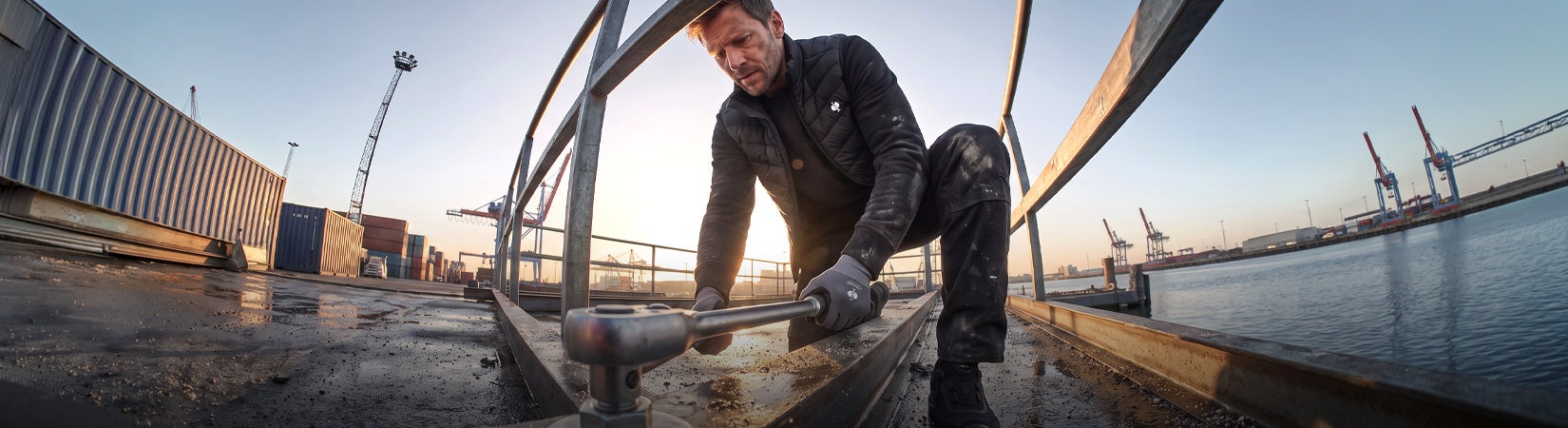
AI-generated / modified – Man in workwear tightens a steel structure with a ratchet beside a harbour basin.
AI
Filter
Popularity
Newest first
Price descending
Price ascending
no filters found
Unfortunately, this service is currently not available. Please try again later.
Size
Colour
Men | Women | Children
e.s. Collection lines
59 Products
More filters59Filter (59)
Popularity
Size
Colour
Men | Women | Children
e.s. Collection lines
59 Products
More filters59Filter (59)
Popularity
Bodywarmer e.s.motion ten
from 
6colours
e.s. T-shirt cotton stretch, long fit
from 
16colours
NEW
Winter bodywarmer padded e.s.line.core
from 
5colours
Ladies' trousers e.s.vision
from 
6colours
e.s. Hoody sweatjacket poly cotton
from 
15colours
Winter jacket e.s.motion ten
from 
5colours
Winter softshell jacket e.s.motion 2020, ladies'
from 
12colours
NEW
Winter jacket padded e.s.line.core
from 
5colours
Bib & Brace e.s.active
from 
11colours
NEW
Softshell jacket e.s.line.core
from 
5colours
NEW
Jacket double climafoam e.s.line.core
from 
5colours


The most important facts about workwear for metalworkers at a glance


  • Locksmith, blacksmith, or metalworker? The official job title is ‘metalworker’. This apprenticeship covers a range of specialisms – from construction engineering to metal design – each with its own workwear requirements. However, in everyday speech, people still often refer to a ‘locksmith’.
  • The selection of clothing depends largely on the activity: Welding work requires certified protective clothing; for assembly work or cold metalworking, sturdy workwear is often sufficient. The relevant risk assessment determines whether welding protection is required.
  • Fit is a safety factor: Close-fitting sleeves and closable pockets prevent clothing from getting caught in machinery and stop chips from getting inside.
  • As a one-stop supplier, Strauss offers workwear for metalworkers as well as protective clothing, safety shoes, and accessories for workshops and building sites from a single range.

Metalworkers: One career path, many facets


In colloquial terms, the term "locksmith" is still used, but the job title dates back to a time when the construction of locks and gates defined the profession. With the restructuring of the training occupations, this became the metalworker – a profession that is significantly broader in scope today. The first two years of training are identical for all aspiring metalworkers, after which they specialise in a particular field.

Each of these specialisms has its own specific requirements for the professional clothing of locksmiths and metalworkers:

  • Structural engineering: Manufacturing and assembly of stairs, gates, façades and hall structures – often alternating between the workshop and the building site, with a corresponding need for weather protection.
  • Metal design: individual bespoke pieces such as ornate railings or blacksmithing work – often involving intensive contact with the forge and thus high requirements for heat and flame protection.
  • Commercial vehicle construction: working on vehicle bodies, often in halls with varying working heights – here, freedom of movement and knee protection are of paramount importance.

In some regions, welding technology is added as a fourth specialisation.

The diversity of the profession is therefore also reflected in the workwear for locksmiths or Metalworkers, for example: those who primarily weld require different protective equipment than someone who installs railings or cold-cuts sheet metal. The right clothing for locksmiths therefore cannot be recommended in general – it depends on the specific task, the field of expertise and the place of work.

Workwear for metalworkers: When is welding protection required – and when is it not?


When welding, forging, or working with an open flame, protective clothing designed to cope with these hazards is required: It must be able to withstand metal spatter, brief contact with flames, and radiant heat.

For assembly work that does not involve welding – such as in railing construction, logistics, or cold metalworking – the situation is different: Here, the focus is generally on mechanical strength rather than heat protection.

The place of work also plays a role: Inside the workshop, protection against metal chips, heat, and moving machine parts is paramount; outside on the building site, weather protection against wind, cold, and moisture is also essential.

Which protection class, standard and equipment are actually relevant in the specific workplace, is determined by the employer’s risk assessment. It takes into account the specific working conditions, procedures, and machinery used on site. It can therefore vary from workstation to workstation – even within the same company.

Workwear for metalworkers includes the right products for different levels of requirement – from standard-certified welding protective clothing to robust workwear for everyday use in the workshop.

Regardless of the specific protection class, the following general principle applies when selecting clothing for metalwork: Loose parts and overly wide sleeves should be avoided so that nothing gets caught in machinery. Closable pockets prevent tools from falling out and chips from getting inside. Workwear should also be checked regularly for defects, tears, or burn holes because damaged protective clothing loses its effectiveness.

Standards for metalworkers – explained in simple terms


Two standards are particularly relevant to welding work in metalworking but are often confused:

Standard
Scope of protection
Special feature
EN ISO 11611
Protection against metal spatter, brief contact with flames, and radiant heat during welding; two protection classes (1 and 2)
specifically for welding and related processes
EN ISO 11612
general protection against heat and flames, including in foundries
in practice, it is often worn as a supplement to EN ISO 11611

Multinorm protective clothing covers all key standards such as EN ISO 11611 (protective clothing for welding) and EN ISO 11612:2015 (protective clothing against heat and flames).

Two examples from the Strauss range: The work jacket e.s.vision multinorm complies with both standards; the fabric has a flame-retardant finish. The matching work trousers e.s.vision multinorm meet the same standards and, when paired with the jacket, complete the multinorm outfit. A pre-shaped knee area with darts provides additional freedom of movement when carrying out installation work on the floor.

Details that make all the difference in metalworking


As well as standards and protection classes, practical features for everyday use are important when it comes to workwear for metalworkers:

  • Tight-fitting sleeves and cuffs prevent clothing from getting caught on rotating machine parts.
  • Closable pockets keep tools secure while also preventing chips from getting inside.
  • Durable materials with polyamide reinforcements on the knees and seat withstand daily contact with rough surfaces and metal edges.
  • Knee pad pockets certified to EN 14404 reduce strain during installation work at ground level such as when installing railings or gates.

When it comes to tool equipment, many metalworking businesses will make good use of a special Tool set for metalworking: The set includes files, combination spanners, heavy-duty combination pliers, water pump pliers, a fitter’s square, a digital calliper, and a fitter’s hammer. Regular welders can add a welder’s hammer for removing slag after welding.

Also the choice of gloves depends on the task: When welding, special welding gloves that offer protection against heat and flames are required; when cutting sheet metal with sharp edges, certified cut-resistant gloves protect against cuts.

To provide eye protection while welding, welding goggles with the appropriate protection level are essential: They provide protection against UV and infra-red radiation from the arc as well as against sparks and metal spatter, which could otherwise cause flash burns or eye injuries. The welding goggles e.s.vision conform to DIN EN 166 and DIN EN 169-5, offer 99.9% UV protection, and are suitable for soldering, gas welding, and overhead welding work.

What material is suitable for workwear for metalworkers?


When it comes to clothing for metalworkers, the fabric determines not only the comfort but also the safety. In work areas where sparks are generated, it is not the type of fibre but rather the certification that matters. Untreated synthetic fibres such as pure polyester can melt when exposed to heat and stick to the skin, thereby posing a considerable risk of injury during welding.

Certified welding protective clothing that conforms to EN ISO 11611 and/or 11612 solves this problem regardless of the type of fibre: The fabric has been treated to be flame-retardant and has been checked for resistance to metal splashes, brief contact with flames, and radiant heat – regardless of whether it is a blended fabric or one with a high natural-fibre content.

For applications where there is no direct risk of sparks – such as assembly work or cold metalworkingblended fabrics containing polyamide are a robust, abrasion-resistant choice.

Work trousers for metalworkers: What matters when it comes to the cut


Above all, a good pair of fitter’s work trousers offers ample storage space without restricting movement when bending over or kneeling. A practical example is the work trousers e.s.motion, which were developed in collaboration with tradespeople from various trades: In addition to polyamide-reinforced knee pad pockets, they feature a multi-compartment ruler pocket, a cargo pocket with a separate smartphone compartment, and a zipped safety pocket for quick access to various tools.

When used in conjunction with certified knee protection conforming to EN 14404, knee pad pockets provide relief during installation work on the ground such as when erecting railings or gates. For tasks involving a lot of material handling or carried out at a welding station, bib & brace trousers provide additional protection against metal chips and draughts around the back. The following applies to all types of trousers: Tight leg cuffs prevent the trousers from getting caught on rotating machine parts.

Work jackets for metalworkers: from welding jackets to softshell jackets


Also when it comes to outerwear, the place of work determines which work jacket is suitable for metalworkers. At the welding station, the standard-certified welder’s or multi-standard jacket such as the work jacket e.s.vision multinorm provides protection against metal splashes and contact with flames and, depending on the version, additional protection against electric arcs and chemicals.

For assembly and workshop work that does not involve welding, softshell jackets are a great choice for freedom of movement. The softshell jacket e.s.motion is windproof, water-repellent, and breathable, and the quilted lining with a thermal reflective zone at the back keeps you warm on cold days. Whether in the workshop or out in the field, a detachable hood and adjustable cuffs provide additional flexibility in changing conditions.

On outdoor building sites (e.g. when erecting fences or steel structures outdoors), a rain jacket provides additional protection against moisture – ideally with taped seams and a hood that can be worn under a safety helmet.

Tip for rain jackets: the EN 343 standard provides guidance on selection. It classifies rainwear into four classes each for resistance to water penetration (waterproofness: the higher the class, the more waterproof the material) and resistance to water vapour (breathability: the higher the class, the more readily perspiration can escape). A high waterproof class also requires watertight, usually heat-sealed seams.

Important for all types of jackets: tight-fitting cuffs to prevent anything from getting caught on machinery or workpieces.

Summer and winter in the metalworking industry: Different requirements for workwear for metalworkers


Depending on the job, metalworkers work in varying temperature and weather conditions – often on the same day. Heat and protective equipment at welding stations expose workers to heat stress while outdoor construction sites in winter expose them to cold and wind. Workwear for metalworkers must be suitable for both extremes.

In summer and in the workshop, breathability must be ensured without compromising mechanical or thermal protection – ventilation features are therefore essential. For outdoor installation work in summer, UV protection such as UV-resistant fabrics or headwear is also important because long working days outdoors expose the skin to sunlight for hours at a time.

For outdoor activities in winter, the layering principle has proven its worth: a base layer that wicks away moisture, a warm insulating layer such as fleece, and a wind- and water-repellent outer layer. Workwear for metalworkers thus remains versatile without the need to buy a completely new set of clothes for every season.

Safety shoes for metalworkers


For safety shoes, different Protection classes are specified depending on the risk assessment: For general day-to-day workshop use, a pair of S3 or S7 shoes that conform to EN 20345 is often suitable.

For those who regularly come into direct contact with hot surfaces, Models with HRO and HI ratings are particularly suitable – HRO stands for resistance to contact heat, HI for heat insulation of the sole.

The S3 safety shoe Pleione mid is the closest thing to a classic welder’s boot and features a quick-release fastening for taking it off quickly in an emergency. Important to know: It does not provide protection in accordance with EN ISO 20349 and therefore does not protect against splashes of molten metal. If there is a corresponding risk associated with welding work involving heavy spatter, this must be taken into account when making a selection.

Strauss: a one-stop supplier for metalworking companies


A metalworking company with fluctuating order volumes and seasonal recruitment needs equipment that is available at short notice – not in four weeks’ time. If you order protective clothing, safety shoes, and welding equipment from different suppliers, it’s easy to lose track of sizes, delivery times, and invoices. Strauss brings together a complete selection of workwear for metalworkers as well as PPE and accessories in a single range:

  • 98% stock availability – can be reordered immediately, even at short notice because of new hires or wear and tear
  • Delivery within 2–4 working days – even for bulk orders for the entire team
  • Sizes from XS to 8XL – including long and short sizes as well as ladies’ fits for mixed teams
  • Volume discounts available even for small quantities – cost-effective even for smaller metalworking businesses
  • Logo service and CI Configurator MYDESIGN for a consistent look at client meetings and on site
  • Long-term availability of the collection – because the same products can be reordered for years to come, there is no need to search for replacements every time they run out

FAQ: Frequently asked questions about workwear for metalworkers


The traditional term is still commonly used, but following a reorganisation of the German vocational training system, the official occupation is now known as ‘metalworker’.

This is set out in the employer’s risk assessment, which takes into account the specific tasks, procedures, and workstations within the workplace. For work involving welding, heat, or flying sparks, the assessment usually requires protective clothing that conforms to EN ISO 11611 or 11612.

That depends on the individual risk assessment. S3 or S7 shoes with heat-resistant soles are often used for a wide range of tasks in metalworking. For regular contact with hot surfaces, models with HRO and HI ratings are a useful addition. When making your selection, you should check specifically for protection against metal splashes in accordance with EN ISO 20349 because not every S3 model includes this additional feature. An S1P safety shoe may also be sufficient for assembly work.

EN ISO 11611 is specifically designed for welding work and provides protection against metal spatter, brief contact with flames, and radiant heat. EN ISO 11612 covers general heat and flame protection; the relevant clothing is often worn in addition to that specified in EN ISO 11611.

Essentially, yes. In metal design, where work often involves close contact with the forge, heat and flame protection are the priority; in commercial vehicle construction, where working heights vary, freedom of movement and knee protection are more important. In construction engineering, where staff frequently move between the workshop and the building site, additional weather protection is required. However, the specific features required always depend on the actual work involved – not solely on the area of specialisation.

It doesn’t necessarily have to be completely new, but the requirements are quite different. In summer and at the welding station, breathability is key without compromising protection. For cold outdoor work, a layered system comprising a base layer, insulating layer, and weatherproof outer layer works well. The individual layers can be easily added or removed to suit different seasons and weather conditions.

Yes, Strauss offers workwear for metalworking companies in both men’s and ladies’ styles. This allows mixed teams to be outfitted consistently with a suitable fit without compromising protection or appearance.

In addition to workwear, a basic metalworking tool set with a fitter’s hammer, combination spanners, and measuring tools is a useful choice. Welders can add a welder’s hammer for removing slag as well as welding gloves, welding goggles, and a welding helmet as PPE.

Strauss France SAS

Phone
01 87 44 95 38
Fax
01 87 44 95 40
Follow STRAUSS
Language selection
fr de en
All prices plus VAT