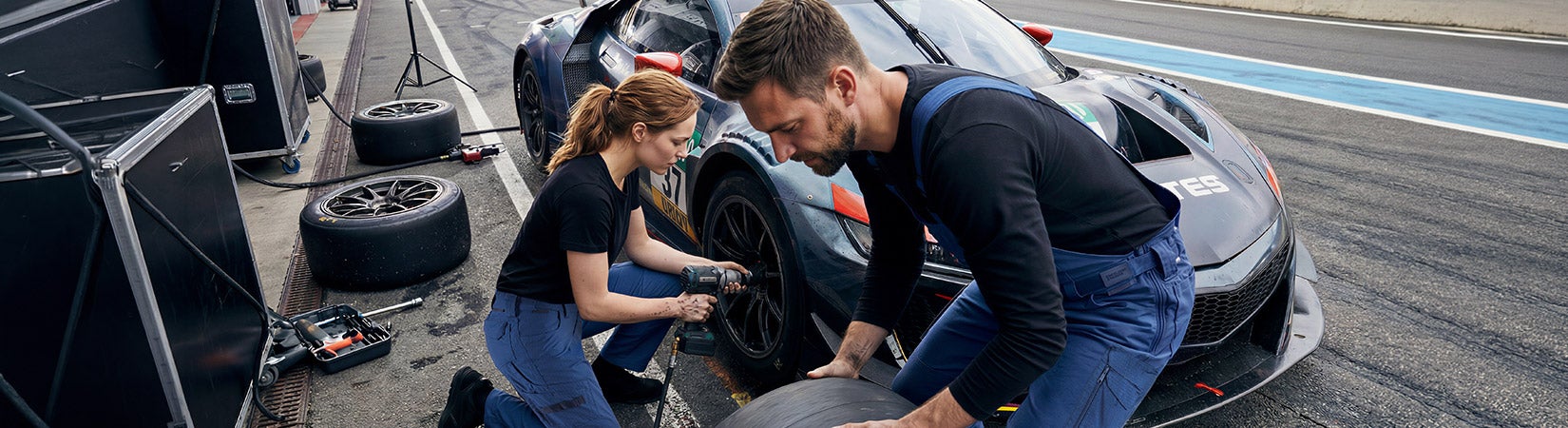
What automotive mechatronics technicians really need in the workshop: clothing, shoes & more
Engine oil, brake fluid, fuels, coolant, sharp-edged metal parts, heavy vehicle components – the day-to-day work of an automotive mechatronics technician places high demands on clothing and protective equipment. Whether you’re working on your knees, under the vehicle or in tight spaces in engines: the right features must be robust, resistant and comfortable to cope with all of this.
The basic equipment in a car workshop includes:
- Work trousers or overalls, hard-wearing, stain-resistant and ideally with a reinforced knee area
- Protective gloves for protection against oil, chemicals and sharp edges
- Work jacket and/or bodywarmer for warmth and protection, whilst allowing freedom to move in the workshop and outdoors
- Work shirts for comfort during long working days
- Safety shoes conforming to EN ISO 20345 (class depending on the nature of the work)
The Occupational Safety and Health Act (ArbSchG §5) requires employers to provide suitable personal protective equipment (PPE) on the basis of a risk assessment. The company covers the full costs. In a car workshop, PPE typically includes safety shoes and protective gloves. Standard workwear for car mechanics, such as trousers, jackets or shirts, is not automatically considered part of PPE. Whether the company provides or pays for these as well depends on its internal policies, the nature of the role and, where applicable, the employment contract.
Work trousers for car mechanics: these materials and features are in demand in the workshop
When it comes to
work trousers and
overalls for automotive mechatronics technicians – or car mechanics, as the profession is still often colloquially referred to – the requirements are clear: They must repel dirt, oil and lubricants, allow full freedom of movement during physical work and withstand daily wear and tear for years. The upper material determines the level of protection and durability. The following have proven their worth:
- Cotton and polyester blend: Cotton ensures comfort and breathability, whilst polyester improves shape retention and speed of drying. Stain-repellent treatments, such as special water-repellent finishes, which make the clothing water- and stain-repellent, prevent lubricants from penetrating the fabric immediately.
- CORDURA® reinforcements on the knees and seat: this high-performance polyamide (nylon) fabric can withstand daily contact with workshop floors and heavy wear and tear.
- Stretch panels: Elastane content or stretch panels allow for full freedom to move when bending down under vehicles, kneeling on the ground and lifting heavy parts.
What else makes a good pair of work trousers for automotive mechatronics technicians:
- Knee pad pockets for use with certified
knee pads for work on the ground; Knee protection conforming to EN 14404 consists of a combination of certified trousers and the corresponding knee pads.
- Triple-stitched seams at high-stress points such as the crotch, seat and pocket openings
- Well-designed pocket layout: smartphone pocket, pen pocket, ruler pocket and cargo pockets for small items and tools
- Reflective elements on the legs for improved visibility in poor light
Whether work trousers or bib & brace – both styles are suitable for use in a car workshop.
Work trousers are quick to put on and take off and can be easily paired with a variety of tops.
Bib & brace are considered practical by many automotive mechatronics technicians when working under a vehicle or in a pit. Overalls have the advantage for car mechanics of covering and providing protection for the whole body. They are particularly handy when you need to change your clothes quickly and completely.
In summer,
3/4 trousers and shorts are also popular options, provided that the risk assessment or workplace health and safety guidelines allow for this. Short trousers that come to just above the knee provide protection for the knees whilst still being breathable.
Layered jackets: for moving between the workshop and outdoor work
Automotive mechatronics technicians do not always work under consistent conditions. Anyone who inspects vehicles outdoors in the morning, works in the pit at midday and spends the afternoon in the air-conditioned diagnostics workshop needs a flexible clothing system:
Functional workwear based on the layering principle really comes into its own here:
- Base layer made of functional underwear: Transports moisture away from the body – important during physically demanding activities, so that sweat does not remain cold on the skin. For long days in the workshop, we recommend functional shirts with flat seams that won’t chafe under your overalls.
- Insulating layer:
Cardigans or
work bodywarmers keep you warm without restricting your freedom to move. They can be quickly taken off and stowed away when the temperature rises or if you get warm whilst working.
- Outer layer:
Softshell jackets are ideal for changeable weather with wind and light rain. In heavy rain or during winter maintenance,
rain jackets with taped seams or winter jackets provide reliable protection against moisture and cold.
Key features to look for in workshop shirts and jackets: an extended back that doesn’t ride up when you bend over, and well-fitting cuffs to prevent anything getting caught in machine parts.
Workwear for female automotive mechatronics technicians
The proportion of women in the automotive trade is growing – and with it the demand for workwear that is actually tailored to female body proportions. Standard cuts in men’s sizes are often not the answer: they restrict freedom of movement, and seams and reinforcements are positioned in the wrong places, thereby compromising both comfort and protection.
Strauss offers
work trousers,
jackets and much more in
ladies' styles – with the same functional features as the men’s models: CORDURA® reinforcements on the knees and seat, stretch panels for freedom of movement, dirt-repellent materials and a well-designed pocket layout. Safety shoes are available in a wide range of sizes and are certified to EN ISO 20345. By the way: for companies kitting out mixed-gender teams, ladies' and men’s styles from the same collections can be combined – for a consistent look with a tailored cut.
Safety shoes for automotive mechatronics technicians: protection classes and requirements
Oil and coolant spills on the workshop floor, loose screws and metal parts lying about, heavy car parts – the range of hazards in a car workshop is wide-ranging. The EN ISO 20345 standard sets out the requirements for safety shoes for industrial use. All safety shoes compliant with this standard are fitted with a toe cap capable of withstanding an impact of at least 200 joules, as well as a slip-resistant sole. In addition, the protection classes differ as follows:
|
|
|
Water-repellent
|
Typical use in a car workshop
|
|
S1
|
no
|
no
|
Light workshop work, dry floors
|
|
S1P
|
yes
|
no
|
Workshop, indoor assembly
|
|
S2
|
no
|
up to 60 minutes
|
Car repair shop, warehouse
|
|
S3 with membrane/ S7
|
yes
|
Waterproof
|
Field work, breakdown service
|
For standard workshop tasks, the BGHM (Employers’ Liability Insurance Association for the Wood and Metal Industries) recommends Class S2 safety shoes as the minimum standard. S1P is also permitted for purely internal work. Anyone who works outdoors or on a tow truck needs S3/S7 footwear with puncture protection and water-repellent or waterproof properties.
Fuel resistance (FO) The new footwear standards have also brought about a change in the requirement for fuel-resistant soles: up until EN ISO 20345:2011, all safety shoes in classes S1–S5 were required to be resistant to hydrocarbons such as oils and petrol. The current EN ISO 20345:2022 standard makes this test optional. Nevertheless, the FO property remains relevant for use in a garage. Almost all Strauss safety and work shoes continue to feature fuel-resistant soles and are labelled accordingly.
Regardless of the protection class, the SRC/SR certification is particularly relevant for car workshops: it certifies slip resistance on smooth, moist or oily floors – the most common types of flooring found in workshops.
The factors that determine comfort during long shifts are weight, cushioning, climate control and
the insole. With many safety shoes, the standard insole can be replaced with certified insoles – a sensible option for those who work regular 8-hour shifts on hard concrete floors.
Gloves for car mechanics: select protection based on the task
Work gloves used in the workshop also face particular challenges: they need to provide protection without hindering the work. Anyone who handles small parts, tightens screws or follows cables needs gloves that do not restrict dexterity.
The right choice depends on the specific job.
- Gloves made from nitrile-coated fabric, such as the Strauss
nitrile gloves Flexible, combine a good grip with oil resistance and are thin enough for precise work on small parts.
- For bodywork involving sharp metal edges, we recommend gloves with cut resistance class B or higher, conforming to EN 388 – such as the Strauss
PU cut-resistant gloves Comfort-Skin cut B.
-
Disposable nitrile gloves Diamond, powder-free made from nitrile provide features for short procedures – they provide protection for the skin from direct contact with chemicals and are quick to change. Thanks to their innovative diamond-patterned surface, powder-free disposable nitrile gloves Diamond are particularly well suited for use in workshops. The textured surface ensures a secure grip – even in case e of oil, fat and moisture.
- Heat-resistant gloves that conform to EN 407 are required when working on hot exhaust systems or engines – such as the Strauss
Aramid latex gloves Cutprotec
- Tip: Our page
Gloves at a glance provides a structured overview by application and protection class. And the ‘Recommended use’ filter in the
Work gloves category helps you quickly find the right protective gloves based on application, material and protection class.
Care and washing: How to make your workwear last longer
Washing the garments correctly significantly extends the lifespan of automotive mechanics’ workwear and preserves the protective properties of the dirt-repellent surfaces.
The following points are crucial:
- Follow the care label: The recommended washing temperature is shown on the label. Many workshop garments are washable at 60 °C – higher temperatures can cause permanent damage to fabrics and stretch panels.
- Pre-treating oil stains: Do not allow fresh oil stains to dry in! It’s best to apply washing-up liquid directly to the stain, leave it to work for a short while and then wash the item – this removes grease much more effectively than washing it without pre-treating it.
- Do not use fabric softener: Fabric softener becomes trapped in the fabric fibres and permanently impairs the water-repellent finish.
- For heavy soiling: A professional industrial laundry cleans in accordance with standards and reliably maintains the protective functions.
Industrial washable workwear: the collection
e.s.industry Anyone who has their team kit cleaned regularly by an external laundry service needs textiles that can withstand this over the long term. The ISO 15797 test standard ensures that workwear retains its shape, colour and protective properties even under industrial washing conditions (high temperatures, heavy mechanical stress) – no pilling, no seam puckering, no colour loss.
Our collection
e.s.industry is designed specifically for this purpose: Trousers, jackets and shirts can withstand wash temperatures of up to 75 °C, making them ideal for garages that have their workwear cleaned centrally and professionally.