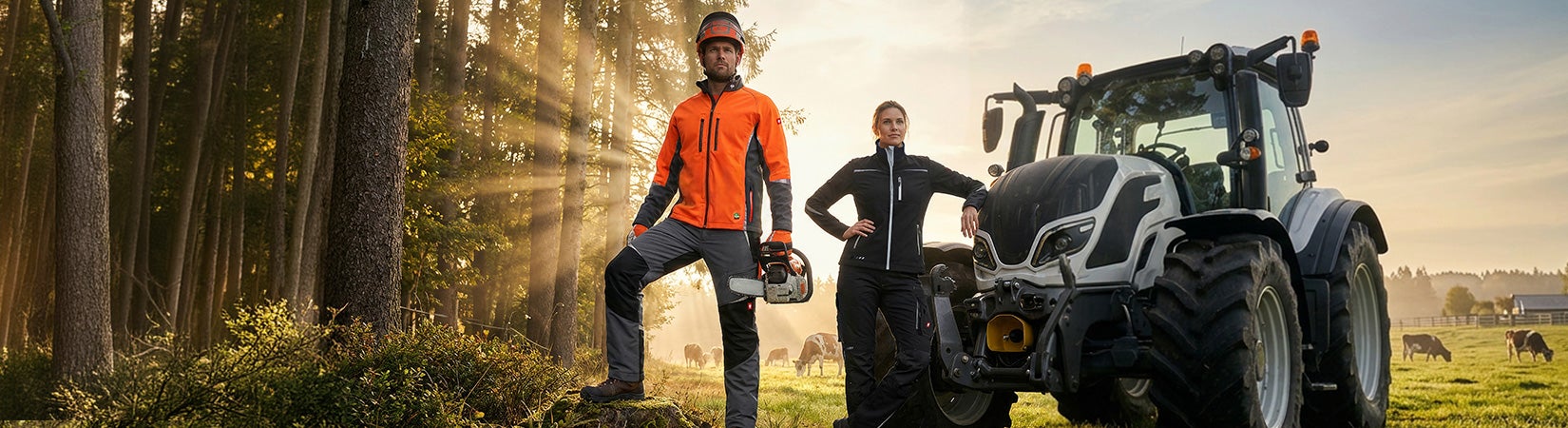
The essentials of clothing for farmers and foresters at a glance:
- Workwear for farmers must combine protection from the elements, allow freedom to move and provide safety.
- For forestry work involving chainsaws, forestry clothing with cut protection conforming to EN ISO 11393 is required by law.
- A basic kit for farmers (trousers, jacket, shoes, accessories) costs roughly between 350 and 700 euros per person.
- As a one-stop shop, Strauss offers a full range of products – with a reorder guarantee and scale prices for businesses.
- Durable materials such as polyamide and reinforced seams significantly extend the product’s lifespan.
Why specialist workwear is essential in forestry and agriculture
Farmers and foresters work every day under challenging conditions: changeable weather, physically demanding work, and contact with machinery and animals. Ordinary everyday clothing cannot withstand these stresses.
Professional clothing for farmers serves three key purposes:
1. Protection – against injuries, the weather, and dirt
2. Function – freedom to move, practical pockets, comfort
3. Durability – robust materials for continuous use
Investing in high-quality clothing pays off for foresters and farmers: less wear and tear, fewer absences due to injuries, and greater comfort during long working days.
The essentials: what farmers and foresters need
Where hard work is done every day, functional workwear is essential. A well-thought-out basic kit consists of several key items: sturdy
work trousers, weatherproof
jackets, safety shoes and work gloves. If you prioritise quality, you’ll save money in the long run and be more comfortable at work. Furthermore, the use of personal protective equipment (PPE) is a legal requirement for foresters – this includes cut-resistant clothing and a forestry helmet with face and ear protection.
Work trousers for forestry and agriculture – the cornerstone of your equipment
Work trousers used in forestry and agriculture have to withstand dirt, liquids, sharp branches or thorns, and sharp edges on a daily basis. But which type of trousers is best suited to which job?
|
|
|
|
|
|
Field, stable, workshop, tree care
|
Freedom to move, easy to put on and take off
|
|
|
Stable work, machinery maintenance
|
Protection against dirt, no slipping
|
|
|
Forestry work using chainsaws
|
Required by law, provides protection against injury
|
Key material characteristics of work trousers for agricultural use:
- Hard-wearing fabrics and blended fabrics (e.g. 65% cotton and 35% polyester) for durability and comfort
- Reinforced at the knees and seat
- Knee pad pockets for ergonomic work
- Triple stitching at stress points
Work jackets – protection in all weathers
In the woods and in the fields, the temperature and weather can change quickly. Anyone who underestimates this risks getting too cold or overheating.
The three-layer principle is the tried-and-tested solution for foresters and farmers:
1. The base layer – a breathable functional shirt – transports sweat away from the body and keeps the skin dry.
2. In addition, a fleece jacket or a knitted fleece provides thermal insulation without feeling restrictive or causing heat to build up.
3. Finally, the outer layer, made of softshell or a sturdy weatherproof jacket, provides protection against wind and moisture – and can be quickly taken off.
For
winter lined thermal jackets with a detachable hood make a good choice as workwear in forestry and agriculture. The key factors here are water-repellent waterproofing and breathable membranes: these prevent sweat from turning into a risk of hypothermia as it cools – an often underestimated risk, particularly when outdoors in sub-zero temperatures.
Safety shoes – essential protection for agricultural work
In the agricultural sector, S3/S7 safety shoes are standard:
- Toe cap (200 joules impact resistance)
- Puncture resistant, anti-slip sole with tread
- Water-repellent upper
Stable work is best carried out in S5 Wellington boots with steel toe caps – they are washable, can be disinfected and are completely waterproof.
Workwear for ladies and men in the agricultural sector – fit, functionality and the right colour
Farming involves physical labour – and workwear needs to reflect that. For men, this means: broad shoulders, reinforced knee pad pockets and deep side pockets for tools, knives or gloves. A waistband with a stretch insert makes all the difference when you're bending down a hundred times a day.
Sizes from S to 5XL and long lengths ensure that even those with a larger build can find a suitable cut.
Ladies has long been working the same jobs on farms and in the forestry sector, but “men’s styles in a smaller size” just don’t work.
Ladies' work trousers with a slimmer waist, an adapted inside leg ratio and a narrower leg width fit better, don't chafe and don't slip.
Jackets with a fitted cut and shorter sleeves allow for precise work without any excess fabric getting in the way. Anyone who works in men’s garments wastes time turning them up – or even risks accidents caused by sleeves that are too long or trouser legs that are too long.
And why is workwear in the agricultural sector so often green or brown? Natural colours have both tradition and a practical purpose: foresters, hunters and forestry workers wear shades of green as a distinguishing mark of their profession. In practical terms, green hides grass and moss stains better than any other colour – and olive shades remain visually appealing even after dozens of washes, whereas light colours quickly start to look grey. Earth tones complement the farmyard and stables visually; dirt and dust are less noticeable, and they evoke a strong sense of nature, just like shades of green. However, for work on roads or involving machinery, high-vis clothing in orange or yellow that conforms to EN ISO 20471 is mandatory – visibility is the top priority here.
Forestry clothing: cut protection and standards
Anyone who works with a chainsaw requires certified forest and forestry clothing that conforms to EN ISO 11393 (formerly EN 381). This standard sets out requirements for protection against injuries caused by chainsaws.
An overview of cut resistance classes
|
Class
|
Chain speed
|
Area of application
|
|
Class 1
|
up to 20 m/s
|
Casual work, firewood
|
|
Class 2
|
up to 24 m/s
|
Professional forestry work
|
|
Class 3
|
up to 28 m/s
|
Special applications
|
Most foresters work with Class 1 or 2. The KWF mark (German Forestry and Forest Technology Board) confirms compliance with the standards.
The basic clothing kit for foresters and forestry workers includes:
- Cut protection trousers (work trousers or bib & brace)
- Cut-resistant boots with steel toe caps
- Forestry helmet with ear protection and visor
- Cut-resistant gloves
Materials and durability: What should I look out for when choosing workwear for forestry and agriculture?
The durability of workwear for forestry and agricultural workers depends largely on the material: anyone who spends their days moving between stables, fields and workshops needs fabrics that can withstand dirt, moisture and mechanical stress over the long term.
Cotton/polyester blend (65/35 or 60/40)
is the classic choice for work trousers and shirts. The cotton ensures comfort and breathability, whilst the polyester content makes the fabric dimensionally stable and fast-drying. For fabric weights of 260 g/m² or more, this blend can easily withstand frequent washing at 60 °C.
Polyamide and CORDURA®
are used in areas where standard fabrics fail: on the knees, the seat and the pocket openings. CORDURA® is up to three times more abrasion-resistant than conventional cotton and withstands thorns, splinters and sharp metal edges. CORDURA® reinforcements increase the durability of workwear for forestry and agricultural workers.
Softshell
combines three properties that are essential for outdoor use: windproofing, water-repellent properties and elasticity. During the transitional period between autumn and spring, a good softshell jacket offers significantly more freedom to move than traditional rain wear – although softshell is only water-repellent, not waterproof.
Canvas
is the heaviest candidate in the selection – with grammages ranging from 350 to 450 g/m². These densely woven cotton fabrics are ideal for bib & braces and overalls that require maximum durability.
Cotton Touch
is a lighter material featuring a weather-resistant wax coating that provides protection against wind and moisture – ideal for changeable weather conditions.
Care tips to help extend the life of workwear for forestry and agriculture:
- Choose hot wash clothing: fabrics that can withstand washing at 60 °C can be cleaned hygienically – important for stable work and contact with animals.
- Reapply the water-repellent treatment regularly: after around five to ten washes, the water-repellent effect begins to wear off. Wash-in waterproofing treatments or sprays restore the protection.
- Close zips before washing: exposed metal teeth can damage other textiles and the zip itself.
- Close the Velcro fasteners: open Velcro attracts fibres and causes it to lose its adhesive strength over time.
- Do not overheat in the tumble dryer: high temperatures damage elastane and membrane materials. A low setting or air-drying is gentler. It is essential to follow the care instructions for the specific product. Not all workwear is suitable for tumble drying.
A one-stop shop for all your forestry and agricultural equipment – the Strauss advantage
Anyone who buys supplies for a farm will be familiar with the problem: trousers from one supplier, shoes from another, cut protection gear from somewhere else – and in the end, the sizes, colours and quality don’t match up.
Strauss offers everything from a single selection:
-
Workwear: trousers, jackets, shirts, overalls
-
Safety shoes: S1 to S7, forestry boots, Wellington boots
-
Cut protection: certified trousers, gloves, boots
-
Occupational safety & accessories by Strauss: gloves, safety helmets, safety glasses, knee pads, braces
- Weather protection: rain wear, winter jackets, functional underwear
Benefits for businesses: a consistent look for the whole team, the ability to reorder for years to come, a logo service for customised corporate clothing, free returns and delivery on invoice.
With the
CI Configurator MYDESIGN you can design your team kit directly online – from just 1 piece for small teams, but also for large companies. Custom designs are added to workwear using high-quality direct embroidery or EasyTransfer printing. Anyone looking for advice will find comprehensive support from the
logo service – a full service for the perfect corporate identity, with a wide range of finishing options.
Professional workwear for forestry and agriculture is an investment in safety, health and efficiency. Durable materials, well-designed features and the right fit ensure you can focus on your work – whatever the weather and whatever the season.
FAQ: Frequently Asked Questions about workwear for forestry and agriculture
Bib & brace or work trousers – which is the better choice for farmers?
Bib & braces offer better protection against dirt and don’t slip down. They are therefore ideal for stable work and work that requires you to bend over. The bib provides additional protection for the tummy and chest area from moisture and dirt. Work trousers are more flexible, easier to put on and take off, and more comfortable in heat or when switching between different activities. Many farmers have both in their wardrobe: bib & brace for the barn, and work trousers for driving the tractor and working in the fields in summer.
Which work trousers are suitable for farm work?
Bib & braces offer the best protection against dirt and stay in place – even when working in a bent-over position or overhead. It is important to choose materials that are washable at high temperatures (at least 60°C for hygiene reasons when in contact with animals), a reinforced knee area with knee pad pockets, and a waistband with a stretch insert. For damp to moist environments such as milking parlours, we also recommend additional water-repellent outer materials such as ‘cotton touch’.
Do I need forestry clothing with cut protection?
Only when working with a chainsaw. For occasional firewood cutting, cut protection class 1 (chain speed up to 20 m/s) is sufficient. Class 2 (up to 24 m/s) is required for professional forestry work or high-performance chainsaws. The cut protection works by using special inserts made of long fibres, which are pulled out upon contact with the moving chain and block it – bringing the saw to a halt in a fraction of a second. Forestry clothing with cut protection is mandatory for all chainsaw operators.
Is there any special workwear for fruit growing or livestock farming?
Yes, but the requirements differ significantly. In fruit growing, lightweight, flexible cuts with stretch are essential for work on ladders and in tree canopies. Tight-fitting clothing without loose parts prevents you from getting caught on branches. In livestock farming, resistance to slurry, disinfectants and organic acids, as well as washability at 60 °C, are essential for hygiene. Poultry farming is subject to particularly strict hygiene requirements – easy-to-clean overalls and special workwear are standard practice here.
Does Strauss also stock KWF-certified forest clothing?
Yes – Strauss stocks cut protection trousers (work trousers and bib & brace), forestry jackets and forestry boots bearing the KWF quality mark. The German Forestry Work and Technology Board (KWF) awards two certifications: ‘KWF Standard’ for products that meet all safety requirements, and ‘KWF Profi’ for equipment that has also passed an additional one-year practical test under professional conditions. Strauss cut protection trousers are KWF-Profi checked, comply with standard EN ISO 11393-2:2019 in cut resistance class 1, type A, and are FPA-accredited.
What safety shoes are part of the correct workwear for farmers?
S3/S7 shoes offer toe protection (200 joules of impact protection), puncture resistance thanks to a steel midsole or textile fabric, water resistance and a sole with tread for grip on slippery surfaces. For stable work involving moisture and slurry, S5 Wellington boots are the better choice – they are easier to clean and disinfect. Tractor drivers who rarely get out of the cab can make do with S1P boots (toe protection and puncture resistance, but not waterproof).
What safety rating do my shoes need as a tractor driver?
For general tractor work, S1P shoes with toe protection and puncture resistance are sufficient – they are lighter and more breathable than work shoes with a higher safety rating. If you regularly leave your tractor to work in the fields, in the barn or on repairs, you’re better off with S3/S7 footwear: waterproof, with a treaded sole for slippery surfaces, fuel-resistant and offering protection against moisture. When working with heavy machinery or in workshops, S3/S7 footwear with additional midfoot protection may also be advisable.
How much does a basic kit for farmers cost?
A basic kit for farmers costs between ca. 2,750 and 5,350 kr.: two pairs of work trousers (ca. 600–1,190 kr.), two work shirts or polo shirts (ca. 300–600 kr.), a softshell jacket (ca. 450–900 kr.), a winter jacket (ca. 600–1,120 kr.), Class S3 safety shoes (ca. 600–1,120 kr.) and accessories such as gloves, a cap and belt (ca. 225–450 kr.). At Strauss, businesses benefit from attractive discounts through scale prices, even on small orders. For teams of any size, it is worth setting up a corporate account with your own terms and conditions.
Can I order workwear for the agricultural sector with a company logo from Strauss?
Yes – using the
CI Configurator MYDESIGN, you can design team clothing yourself directly online.
How it works:
- Select product and the customisation option (T-shirts, jackets, trousers, caps and more),
- Upload your own logo as a file (PDF, JPG, EPS) or select from over 150 designs in the database,
- Set the position and size,
- Check the preview and order.
We offer hard-wearing embroidery and EasyTransfer printing – even for single items and with no minimum quantity.
Don't feel like designing it yourself, or don't have the time? With the Strauss logo service, teams of any size can get advice on design – our experts are happy to help. What’s more, the
logo service offers a range of finishing techniques, from screen printing to laser engraving: it’s well worth a look!