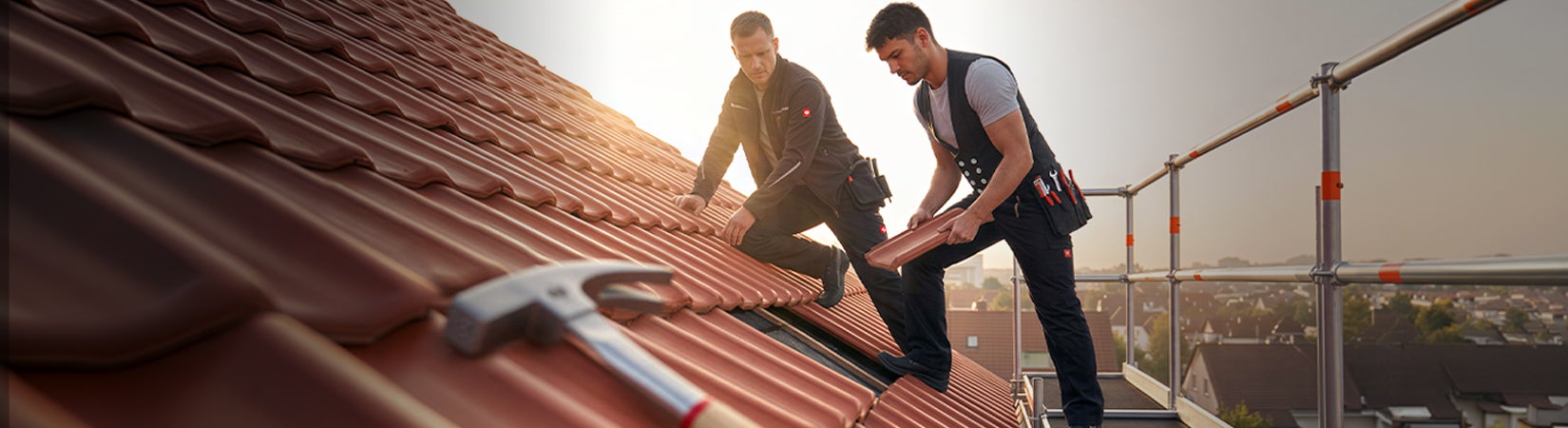
What workwear for roofers needs to offer
According to the Construction Trade Association (BG BAU), roof work is one of the activities associated with an increased risk of falling from a height. Workwear for roofers must be cut in such a way that it does not hinder safe climbing, bending and kneeling – it should be close-fitting in critical areas whilst still allowing for ease of movement. Three further factors shape the day-to-day work of roofers: Mechanical wear and tear and physical strain caused by kneeling on rough surfaces such as slate or bricks Variations in weather conditions ranging from frost to heat over much of the year UV radiation whilst working for hours on end without any shade Tear resistance at the knees and on the seat is particularly important when carrying out slate work, as sharp-edged fragments wear through fabric more quickly than smooth roof tiles.
The right trousers: key when selecting workwear for roofers
Laying bricks, cutting slate to size, sealing joints: Much of this work is carried out whilst kneeling on rough ground, often for hours on end. This constant strain takes its toll on the knee joints in the long term – which is why knee osteoarthritis is recognised as an occupational disease amongst roofers and those in other professions that place a strain on the knees. The right workwear can minimise the strain.
What matters when it comes to work trousers for roofers:
- Knee pad pockets: They accommodate external knee pads that help protect the kneecap and joints – not just an extra comfort feature, but active health protection. Certified knee pads comply with the requirements of EN 14404, which sets out standards for shock absorption and pressure distribution on the kneecap.
- Free climbing and ascending: Nail pouches on trousers keep nails, screws and small parts within easy reach, without tools sliding about loose or leaving you without a free hand to hold them.
- Freedom to move when bending down and climbing: An elasticated waistband gives way when you move, without the trousers slipping down.
- Strength at the knees and buttocks: Rough surfaces such as slate or brick wear through fabrics more quickly than smooth surfaces. Reinforced materials help to extend the service life in this case.
- Tools within easy reach on the body: Cargo pockets, folding rule pockets and, where applicable, additional tool bags mean you don’t have to keep reaching up to the toolbox on the roof.
Two trouser styles from the
e.s.motion ten collection meet these requirements perfectly. The
work trousers e.s.motion ten combine a high cotton content with T400 Stretch and CORDURA®NYCO, making them particularly durable and stretchy. In addition, there are knee pad pockets with top-loading access and Velcro fasteners, a multi-compartment cargo pocket for tools and small items, and a separate ruler pocket. The Flexbelt® waistband, which is elasticated, gives an additional amount of give when climbing or bending over, without slipping.
Anyone who frequently needs to have tools within easy reach, worn on the body, will find the
work trousers e.s.motion ten tool-pouch a practical addition: Two additional tool bags on the waistband hold a hammer, screwdriver and small parts in loops and compartments – handy, for example, when laying roof battens, when you need tools to hand quickly. When not in use, they can be tucked away in the deep side pockets to save space.
Tip: With extra
tool bags for the belt or waistband, trousers can be customised with flexible pocket solutions – exactly as required by the task at hand or the demands of the working day.
The right jacket for changing weather conditions on the roof
Roofers are extremely exposed to the elements. And: The weather often changes within a matter of hours, alternating between wind, rain and blazing sunshine.
3-in-1 jackets combine a weatherproof outer jacket with a removable inner layer, allowing them to adapt to the season and the occasion. The
3-in-1 functional jacket e.s.motion 2020 combines an EN 343-certified, waterproof and windproof outer jacket with a zip-off Thermostretch fleece inner jacket, which can also be worn on its own – handy for the transition from a cold, wet morning to a warmer afternoon on the roof.
Softshell jackets offer stretch for climbing and hiking, whilst being windproof and often water-repellent too. For roofers, this is doubly important, because restricted mobility at height can quickly become a safety hazard. Strauss has several softshell jackets in its selection that are perfectly tailored to the needs of roofers:
- The
softshell jacket e.s.motion 2020 is ideal for spring and autumn: Lightweight, stretchy and featuring fleece on the inside, it fits snugly against the body and doesn’t restrict movement when working on the roof.
- As soon as the temperatures drop, the
softshell jacket e.s.motion with its warm quilted lining, a thermal reflector zone on the back and robust CORDURA® reinforcements in high-wear areas such as the breast pocket and sleeves, offers additional protection against the cold and wear and tear caused by roof tiles or slate.
- The
winter softshell jacket e.s.motion 2020 is a lined version with underarm ventilation – handy when physical exertion whilst roofing generates heat, but the outside temperature remains wintry.
UV protection and headgear
Roofers often work in the blazing sun –
UV protection is therefore essential. Work shirts with UV protection and breathable fabric, such as the
functional T-shirt UV e.s.trail, reduce this strain without making you feel any hotter in the heat. With its long sleeves, the
e.s. Functional hoody longsleeve offers UV protection and feels light against the skin, thanks to its breathable and fast-drying fabric.
Headgear is essential when working on the roof on hot days. Headgear with neck protection such as the
e.s. Functional cap UV covers the areas that are particularly exposed when looking up or down. Particularly practical: thanks to the three ways of wearing it – with the sewn-on neck flap folded out, the neck flap fastened at the front with Velcro, or as a normal cap (with the neck flap tucked away inside the cap) – it can be adjusted to suit individual preferences and the situation.
Safety shoes for roofers: a firm grip and non-marking soles
As well as a secure grip and reliable protection, there is another feature that is particularly important in shoes for roofers: Shoes should, as far as possible, leave no scuff marks on roof tiles and must at the same time provide good grip on wet or mossy surfaces. A rubber toe cap provides additional protection for the shoe when working on your knees and increases the durability of the upper.
Amongst roofers the most common protection classes are
S3 and
S7. S3 refers to safety shoes with toe protection, a closed heel, puncture protection and a treaded, slip-resistant sole. S7 provides additional protection against water ingress during prolonged contact with moisture.
There are special models available for the roofing trade that are tailored to these requirements. These include the S3 roofing safety shoes e.s. Erlangen with a slip-resistant rubber/EVA solein accordance with slip resistance class SR, as well as a rubber scuff cap for work requiring kneeling. The
S3 roofing/ceiling construction shoes e.s. Bayreuth offer similar basic features and, in addition, a secure lacing system.
In blacktop construction, there are further requirements to be met. In this context, soles with a heat-insulating underlay, marked HI, and resistance to contact heat, marked HRO, are particularly important. These features provide protection for the shoes when they come into contact with hot bitumen or freshly laid waterproofing membranes. In addition, fire-resistant shoelaces and heat-resistant seams made from Nomex® prevent fastenings from coming undone due to heat. A standard S3 shoe without an HI sole and without heat-resistant materials is not sufficient for this purpose. Both of the models mentioned above meet these requirements and are heat-resistant up to approx. 200 °C, and up to approx. 300 °C for short periods.