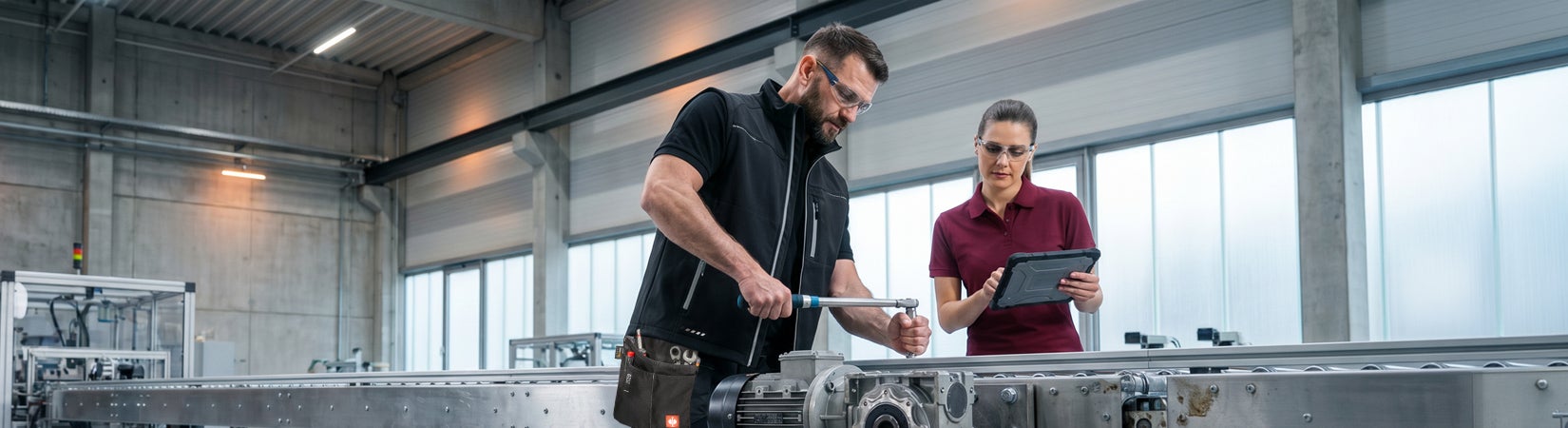
Workwear for industrial mechanics: the essentials at a glance
- Workwear for industrial mechanics must withstand constant exposure to metal shavings, lubricants and mechanical stress – whilst allowing full freedom to move when working overhead and in confined areas of the plant.
- Personal protective equipment (PPE) such as safety shoes, safety glasses, work gloves and knee protection conforms to EN 14404 is the employer’s responsibility – the costs must not be passed on to employees.
- For fluctuating temperatures in production halls, the three-layer principle proves its worth: a work shirt, a work bodywarmer, and a fleece or softshell jacket.
- The BGHM recommends Class S3/S7 safety shoes – with puncture protection and anti-slip soles – for high-risk tasks in metalworking.
- As a one-stop supplier, Strauss provides everything industrial businesses need – workwear, shoes and
occupational safety equipment from one selection, with volume discounts and a logo service.
What distinguishes workwear for industrial mechanics from standard workshop clothing?
Anyone wondering whether a simple pair of cargo trousers and an old T-shirt are really enough for an industrial mechanic will quickly find the answer in the day-to-day reality of production. Industrial mechanics do not just work with tools and machines – they work on machines that are running, under pressure or filled with corrosive fluids.
These are the typical stresses and strains that workwear for industrial mechanics must withstand:
|
|
|
|
Metal shavings, sharp edges
|
Abrasion-resistant materials, close-fitting sleeves with Velcro fasteners or cuffs
|
Hydraulic oils, lubricants, coolants
|
Stain-resistant finish, chemical-resistant surfaces
|
Confined areas, working overhead
|
Stretch panels, extended back
|
|
|
Knee pads and work trousers that conform to EN 14404, with CORDURA® reinforcements
|
Fluctuating temperatures in halls
|
A layered outfit consisting of a work shirt, a functional troyer and a bodywarmer or fleece jacket
|
Areas at risk of electrostatic discharge (depending on the activity)
|
ESD-certified clothing conforming to EN 61340-5-1
|
Essential kit for industrial mechanics: What workwear do you need right from the start?
Anyone starting out in the profession must provide their own full kit or be provided with it by their employer. The following table shows which items of workwear are part of the standard kit for industrial mechanics:
|
Product
|
Quantity
|
Note
|
|
|
2 pieces
|
Depending on your preference
|
|
|
3–4 pieces
|
Ideally breathable and quick-drying
|
Bodywarmer and
work jacket
|
1 piece of each
|
For outdoor use and cooler indoor areas
|
Safety shoes (S2 or S3/S7, SRC/SR)
|
1 pair
|
Depending on the job profile and risk assessment
|
|
|
2–3 pairs
|
Oil resistance, grip and dexterity – perfect for gearbox assembly, etc.
|
|
|
1 box
|
Standard for protection during brief exposure (e.g. to sensors, chemicals)
|
A full starter kit for industrial mechanics costs between 3.870 and 7.200kr per person, depending on the choice and number of products, the quality of the materials and the protection class.
Important for businesses and all employees: In accordance with the Occupational Safety and Health Act (ArbSchG § 5), the employer must provide and pay for all personal protective equipment (PPE), such as safety shoes, protective gloves and certified knee protection, following a risk assessment. Standard workwear for industrial mechanics that does not provide protection is not covered by this, but in practice is often provided or paid for by the employer.
Additional provisions also apply to training companies and trainees: Under Section 14 of the Vocational Training Act (BBiG), trainees must be provided with all necessary training equipment free of charge – this includes PPE and, where applicable, workwear specific to the occupation.
Work trousers and overalls for industrial mechanics
Work trousers are the essential item of clothing in the day-to-day work of an industrial mechanic. Three types of trousers are commonly found in practice. All of them are suitable for industrial mechanics; it usually comes down to personal preference.
-
Work trousers: Classic cut with a waistband, making them quick to put on and take off. Goes well with various layers of tops. Stretch panels allow for full freedom to move when bending down under equipment or working overhead.
-
Bib & brace: The bib & brace ensure a particularly secure fit when bending down, working in a crouched position or working overhead.
-
Overalls: Covers the entire body and provides full protection for the clothing underneath from oil, dirt and lubricants. Particularly handy when you need to change your clothes quickly and completely.
Regardless of the type, the same applies to all three: quality is evident in the details. What makes a good pair of work trousers for industrial mechanics?
- CORDURA® reinforcements on the knees and seat – this high-performance polyamide (nylon) fabric is designed to withstand daily contact with hard machine floors and sharp edges on machinery.
- Work trousers and knee pads in accordance with EN 14404/knee protection – Work trousers with knee pad pockets for use with certified
knee pads during groundwork
- Reinforced seams at the crotch, back and pocket openings: the areas most prone to wear and tear
- Well-designed pocket layout: Your smartphone, folding rule, screwdriver, pens and small items are within easy reach without getting in the way when you’re kneeling or bending down.
- Dirt-repellent finish, e.g. using special in-wash waterproofing treatments, which make the clothing water- and dirt-repellent.
- Our
collection e.s.industry has been specially designed for the rigours of everyday workshop life: Trousers, jackets and shirts are washable at up to 75 °C and are therefore suitable for businesses that have their workwear cleaned centrally by a professional laundry service.
Outerwear for industrial mechanics: the layering principle wins
Fluctuating temperatures are the norm in day-to-day production: cooler areas within the warehouse, outdoor work during goods receipt, or service calls in poorly heated parts of the building. If you only have one jacket, you either take it off too rarely or put it on too rarely. The three-layer principle systematically resolves this problem.
- Base layer (functional shirt): transports moisture away from the body, keeping the skin dry even during physical activity. Flat seams ensure comfortable wear.
- Heat layer (
fleece jacket or
work bodywarmer): provides insulation during breaks and periods of low activity, and can be quickly removed during intensive work. A bodywarmer leaves your arms free – which is handy for assembly work where full range of movement is required.
- Outer layer (e.g.
softshell jacket): provides protection against wind and light splashes, whilst remaining flexible enough for working overhead and in confined spaces.
For industrial mechanics, two features are particularly important: the extended back prevents the jacket from riding up when bending down under machinery. Tight-fitting cuffs – with Velcro fasteners or knitted cuffs – keep the sleeves securely in place near moving machine parts.
Standards and PPE requirements in metalworking
Protective clothing in industry is not something to be left to chance. Relevant standards specify what clothing must be able to do – and what this means in practical terms for the wearer:
- EN ISO 13688 is the basic standard for protective clothing. It sets out general requirements regarding ergonomics, safety, sizing and labelling – all certified protective workwear must comply with this standard.
- EN 14404 sets out requirements for knee protection when working in a kneeling position. Knee pads manufactured to this standard are classified as Type 1 (for hard floors) and Type 2 (for soft or uneven surfaces). For industrial mechanics who regularly kneel on concrete floors or metal grating, certified knee protection is not just a matter of comfort – it is about long-term joint protection.
- EN 61340-5-1 (ESD protection) applies whenever industrial mechanics are working in areas at risk of electrostatic discharge – for example, when maintaining control components, frequency converters or sensor systems. ESD-certified clothing safely dissipates electrostatic charges and provides protection for sensitive electronic equipment from damage caused by static discharge. Whether ESD protection is required is determined by the workplace risk assessment.
DGUV Rule 112-189 provides employers with guidance on the use of protective clothing: it specifies which protective clothing is suitable for which hazards – mechanical impacts, thermal stress, chemicals – and how the selection should be made on the basis of a risk assessment. The relevant employers’ liability insurance association for industrial mechanics is the BGHM (Employers’ Liability Insurance Association for the Wood and Metal Industries).
Safety shoes for industrial mechanics – which protection class is mandatory?
Metal shavings on the floor, oil and coolant residues on concrete floors, heavy components – the hazards associated with metalworking make
safety shoes conforming to EN ISO 20345 a necessity. All shoes manufactured to this standard are fitted with a toe cap that can withstand an impact of at least 200 joules. The protection classes also differ as follows:
|
Protection class
|
Puncture protection
|
Water-repellent
|
Typical application
|
|
S1P
|
yes
|
no
|
Dry production areas, simple indoor installation
|
|
S2
|
no
|
up to 60 minutes
|
Workshop, low-risk maintenance
|
|
S3/S7
|
yes
|
Yes (S7 is even waterproof)
|
High-risk metalworking, outdoor use
|
The BGHM recommends
Class S3 safety shoes for high-risk activities in metalworking or.
S7 – with puncture protection and a profiled sole. The specific class required is determined by the company’s risk assessment.
Regardless of the protection class, the SRC/SR certification is particularly relevant for industrial mechanics: it certifies slip resistance on smooth, moist or oily floors – typical surface conditions found in production halls and workshops.
Anyone who works in areas at risk of electrostatic discharge must also have ESD labelling on their shoes. ESD shoes dissipate electrostatic charges in a controlled manner via the soles, preventing discharges from affecting sensitive components.
A full range of equipment for industrial businesses – Strauss: a reliable partner
Uniform features for an entire workshop team – that sounds easier than it often is. Different suppliers, missing sizes and unsuitable quality make procurement more time-consuming than it needs to be. This is particularly time-consuming and stressful in manufacturing companies with a large workforce or frequent new hires. Strauss supplies the full selection of products from a single selection – Workwear, safety shoes and protective equipment – in a single order:
- 98% stock availability – Reorders and new stock without waiting times, even for last-minute requirements
- Delivery within 2–4 working days – even for bulk orders for entire teams
- Sizes from XS to 8XL – including long and short sizes, as well as ladies' fits for mixed teams
- Volume discounts available even for small quantities – Volume savings are worthwhile even for smaller businesses
-
Logo service &
CI Configurator MYDESIGN – Design and customise workwear with ease
- Long-term collection availability – the same products can be reordered for years to come; no need for time-consuming searches when replacements are required
E-procurement: bespoke procurement solutions for automotive businesses With Strauss MyShop, businesses can set up a bespoke B2B webshop that can be integrated into existing ERP systems. The selection can be tailored to your specific needs, orders are dispatched directly bearing your company logo, and a flexible role-based system allows procurement managers to keep track of budgets and authorisations.
FAQ: Frequently asked questions about workwear for industrial mechanics
Is a standard overall suitable for industrial mechanics?
Work overalls provide protection for the clothes underneath from oil and dirt – that is their clear advantage. However, it is only suitable as workwear for industrial mechanics if it is designed to withstand the specific stresses involved: abrasion-resistant material, close-fitting sleeves with no loose ends, and a dirt-repellent surface.
What is the difference between workwear and PPE?
Workwear provides protection against dirt and wear and tear, but is not automatically classified as personal protective equipment (PPE). PPE refers to clothing or equipment that provides protection against a specifically defined hazard – for example, safety shoes that conform to EN ISO 20345, knee protection that conforms to EN 14404 or ESD clothing that conforms to EN 61340-5-1. The employer’s risk assessment determines which equipment is classified as PPE.
What PPE must the company provide – and who pays for it?
Under Section 5 of the Occupational Safety and Health Act (ArbSchG), the employer is obliged to provide suitable PPE on the basis of the risk assessment. The company must cover the full cost of purchase, cleaning and spare parts – employees are not required to contribute to these costs. Standard workwear that does not provide protection is not automatically classified as PPE. Whether the company provides them depends on internal policies and the employment contract.
Is the training company required to provide industrial mechanic trainees with workwear?
Under Section 14 of the Vocational Training Act (BBiG), training organisations are obliged to provide trainees with the training materials necessary for their training free of charge. This also includes workwear, provided it is required for the training. PPE must always be provided and paid for by the employer. If in doubt, the relevant Chamber of Industry and Commerce (IHK) or the Federal Institute for Occupational Safety and Health (BGHM) can provide information on the specific obligations.
S1P or S3/S7 – which safety shoes do I actually need as an industrial mechanic?
The employer’s risk assessment forms the binding basis. For guidance: The BGHM recommends S3/S7 footwear for high-risk activities in metalworking – with puncture protection and a profiled sole. S1P is permitted for indoor use only on dry floors where the risk is low. In any case, SRC/SR certification for slip resistance on oily floors must be in place.
As an industrial mechanic, do I need ESD protective clothing?
Not as a general rule – but in certain applications, yes. Anyone who works with control components, frequency converters, sensors or other electrostatic-sensitive components needs ESD-certified clothing that conforms to EN 61340-5-1 and ESD shoes. The risk assessment determines whether ESD protection is required. ESD clothing must not be washed with fabric softener, as this destroys its conductive properties.
What is the correct way to wash oil-stained workwear worn by industrial mechanics?
Pre-treat oil stains with washing-up liquid immediately after your shift, leave it to work for a short while, then wash at the temperature specified on the care label – usually 40 to 60 °C. Do not use fabric softener, as it will permanently damage waterproofing and ESD treatments. If clothing is heavily soiled, we recommend using a professional industrial laundry service that cleans in accordance with industry standards and preserves the protective properties of the fabric. For businesses that regularly have their team uniforms professionally laundered, Strauss offers workwear specifically designed for this purpose in its
e.s.industry collection.
How much does a starter kit for industrial mechanics cost?
A full basic kit – comprising two pairs of work trousers or overalls, work shirts, bodywarmers, work jackets, safety shoes and gloves – costs between 3.870 and 7.200kr per person, depending on the quality of the materials, the protection class and the number of items included. For businesses that are kitting out several employees at the same time, it is worth purchasing in bulk to take advantage of volume discounts, which can significantly reduce the cost per person.
Is there workwear available for female industrial mechanics and mixed-gender teams?
Yes. Standard cuts in men’s sizes often do not fit well on women’s bodies – this restricts their freedom to move and compromises the protective function. Strauss offers
work trousers,
jackets and much more in
ladies' cuts with the same functional features as the men’s models: CORDURA® reinforcements, stretch panels, dirt-repellent finish and well-designed pocket layout. Safety shoes are also available in a wide range of sizes and are certified to EN ISO 20345. Men’s and ladies' styles from the same collections can be mixed and matched – ensuring a consistent look across a mixed-gender team.